
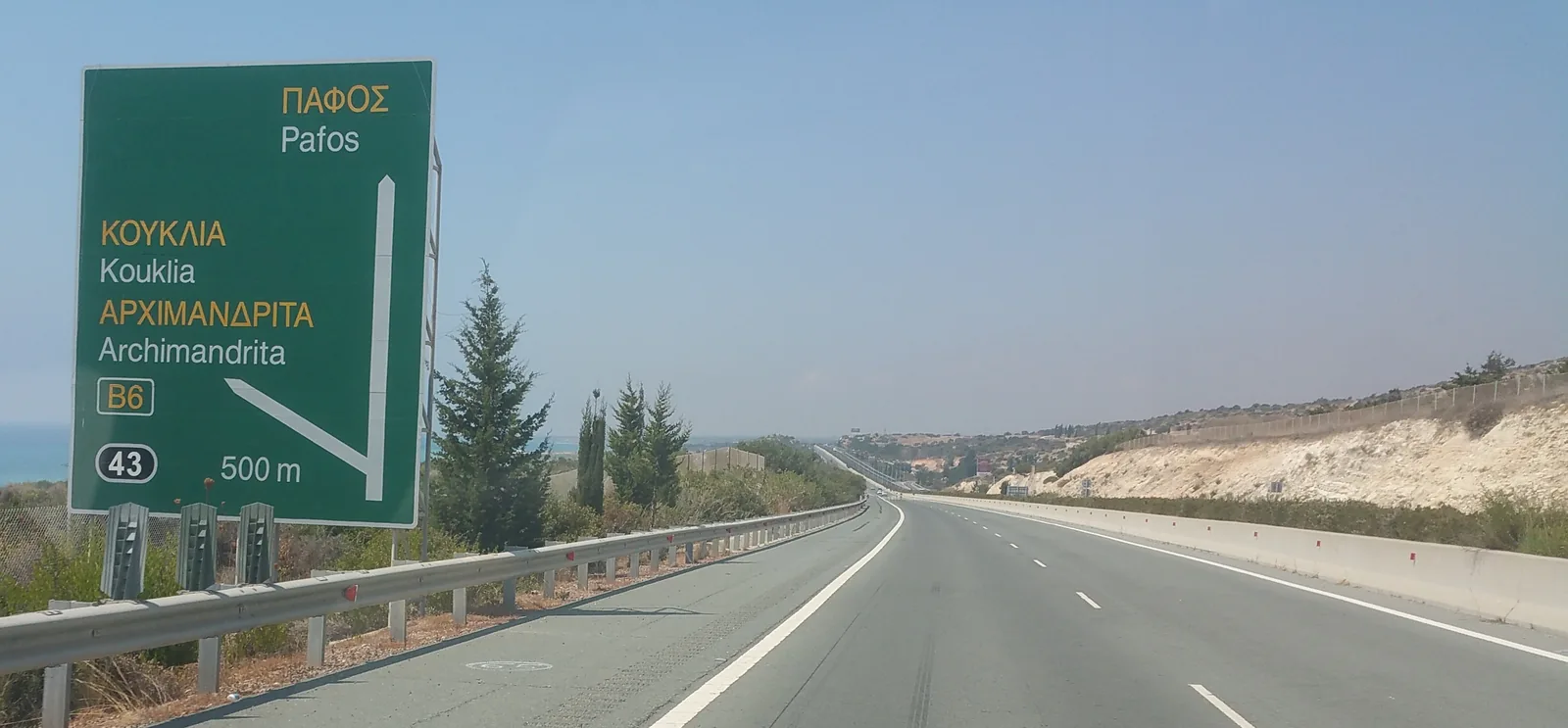
Cyprus is one of the easiest places in Europe for British visitors to drive, because traffic keeps to the left, just like at home. Even so, there are a few local rules and rental quirks worth knowing before you pick up the keys. This guide to car hire in Cyprus covers license rules, insurance excess, red rental plates, driving to the north, fuel, tolls and age limits, using official sources.
Quick answer
- License: a UK photocard driving license is enough, and you don’t need an International Driving Permit (IDP). With an old paper license, however, you may need an IDP as well.
- Side of the road: Cyprus drives on the left, so the rules of the road will feel familiar.
- Insurance: basic cover usually comes with a high excess, so decide in advance how you’ll reduce it.
- The north: hire car insurance from the Republic usually doesn’t cover the north, and some rental firms ban the crossing altogether.
- Costs on the road: there are no motorway tolls, and fuel stations have card machines for out-of-hours use.
- Age: drivers under 25 with less than three years’ experience must tell the rental company, and age limits vary by firm.
Hiring a car? Compare car hire from local Cyprus firms (Localrent), then check the deposit, insurance excess and cross-border rules in the offer before you book.
Or search by pick-up point: Larnaca, Paphos Airport or Limassol.
Affiliate links: Localrent is a car hire booking site that lists cars from local rental firms. If you book through our links, we may earn a commission at no extra cost to you. See our affiliate disclosure.
Car hire in Cyprus: the key rules compared with the UK
The table sums up the main differences. Most rules are similar to the UK’s, but the speed limits are in km/h and the drink-drive limit is lower than in England and Wales.
| Rule | Cyprus | UK |
|---|---|---|
| Side of the road | Left | Left |
| Motorway speed limit | 100 km/h (62 mph), minimum 65 km/h | 70 mph |
| Other roads outside towns | 80 km/h (50 mph) unless signed | 60 mph on single carriageways |
| Built-up areas | 50 km/h (31 mph) unless signed | Usually 30 mph or 20 mph |
| Drink-drive limit | 50 mg per 100 ml of blood; 22 µg per 100 ml of breath | 80 mg and 35 µg in England, Wales and Northern Ireland; 50 mg and 22 µg in Scotland |
| Lower limit for new drivers | 20 mg (blood) or 9 µg (breath) if licensed for under three years | No separate limit |
| Motorway tolls | None | Very few |
| Hand-held phones | Banned | Banned |
Do UK drivers need an International Driving Permit?
According to GOV.UK, you can use a UK photocard driving license to drive in Cyprus. If you still have a paper license, though, you may need to update it to a photocard or get the correct type of IDP too. The Cyprus Deputy Ministry of Tourism also confirms that visitors can drive with a valid national license for the right class of vehicle.
In practice, rental companies will also ask for a credit card in the main driver’s name for the deposit, so check this before you travel. Note that GOV.UK warns some firms ask for your passport as a deposit, which is illegal, so never hand it over.
Driving on the left
For UK drivers, this is the big advantage of Cyprus: you keep left, overtake on the right, and go clockwise around roundabouts. Hire cars are typically right-hand drive, so the controls will feel familiar too. That said, GOV.UK notes that driving standards are poor and the risk of road deaths is higher than in the UK, so drive defensively. Seat belts are compulsory in the front and back. In addition, children under 1.5 m tall must use a suitable seat or restraint.
Car hire in Cyprus: insurance excess explained
With car hire in Cyprus, most rental prices include basic insurance, usually called a Collision Damage Waiver (CDW). However, it comes with an excess, which is the amount you pay if the car is damaged, and it can run to several hundred euros or more. The rental desk will usually offer extra cover to reduce the excess to zero.
You generally have three choices:
- Accept the excess: it’s the cheapest option, but a large sum is held on your credit card during the rental.
- Buy the rental company’s extra cover: it’s the simplest option at the desk, although it’s often the most expensive per day.
- Buy separate excess insurance before you go: it’s often cheaper, but you’d pay the rental firm first and then claim the money back.
Whatever you choose, read what’s excluded. Tires, glass, the underside of the car and damage on unpaved roads are common exclusions. Also, take photos and a video of the car at pickup and drop-off.
Red plates: how to spot a rental car
Rental cars in Cyprus have red number plates, which is why they’re also known as “Z cars”. Older rental plates start with the letter Z, although newer ones no longer use the prefix. In other words, everyone on the road can see that you’re a visitor, so keep valuables out of sight when you park.
Driving to North Cyprus in a hire car
You can cross the Green Line into the north at the official crossing points. However, GOV.UK warns that cars hired in the Republic often have no insurance cover in the north. You won’t be allowed through a crossing without the right insurance documents. At some crossing points, including Agios Dometios in Nicosia, you can buy separate insurance for the north.
- Check your rental contract first: some companies don’t allow their cars in the north at all, and breakdown cover may stop at the Green Line.
- Use a vehicle crossing: the Ledra Palace and Ledra Street crossings in Nicosia are for pedestrians only.
- Take your passport: you’ll need it at the crossing, and time in the north counts toward your 90-day visa-free stay.
- Watch customs limits: the Republic limits goods brought back from the north, for example 40 cigarettes per person.
Fuel, tolls and parking
There are no motorway tolls in Cyprus, so the main costs are rental, insurance and fuel. Petrol stations sell unleaded and diesel. According to the Deputy Ministry of Tourism, staffed hours are shorter on weekends and some afternoons. Even so, most stations have automatic pumps that take cards and banknotes when they’re closed.
When you compare car hire in Cyprus, check the fuel policy before you book. A full-to-full policy, where you return the car with a full tank, is usually the fairest. Parking in town centers is mostly in paid car parks or at meters, while villages and beaches often have free parking.
Age rules for car hire in Cyprus
Minimum and maximum ages vary by rental company, so check the terms before you book. Under-25s often pay a young-driver fee. Officially, drivers under 25 who have held a license for less than three years must tell the rental company, so that the right insurance cover is in place. Some firms also have an upper age limit or ask older drivers for extra checks. Likewise, every extra driver must be named on the contract and usually costs extra.
Where to pick up a car
Most visitors collect a car at Larnaca or Paphos airport, where the major firms and many local companies have desks. Others deliver to hotels in the main resorts. If you won’t need a car on day one, you could take a bus or transfer first. Our guides to getting from Larnaca Airport and getting from Paphos Airport compare the options. Picking up at one airport and dropping off at the other is possible, but it may carry a one-way fee.
Is car hire in Cyprus worth it?
If you’re staying in Larnaca, Limassol or Kato Paphos and mainly want the beach, you can manage with buses, taxis and tours. On the other hand, a car is close to essential for villas, the Akamas peninsula, the Troodos Mountains and the wine villages. The motorways between the main towns are good, but mountain roads are narrow and winding. In winter, check snow and ice warnings before you drive up to Troodos.
Planning a road trip? Compare villas and hotels with parking across Cyprus for your dates.
Affiliate link: our accommodation links go through Stay22, which sends you to a booking site such as Booking.com, Expedia or Vrbo. If you book, we may earn a commission at no extra cost to you. See our affiliate disclosure.
Then, once you’ve sorted the car, read our guides to Paphos, Limassol and Ayia Napa and Protaras to choose a base.
Related guides
- Larnaca or Paphos: which airport should you fly into?
- Larnaca Airport transfers
- Paphos Airport transfers
- Cyprus winter sun: weather by month and where to go
Plan your trip to Cyprus
- Flights: search flights to Larnaca and Paphos from the UK and Europe, or read our guide to choosing between the two airports.
- Hotels and apartments: compare places to stay across Cyprus (affiliate link), or start with our where-to-stay guides.
- Airport transfers: pre-book a private transfer with GetTransfer (affiliate link), or see our Larnaca and Paphos airport guides for buses and shuttles.
- Car hire: compare car hire from local Cyprus firms (Localrent) (affiliate link), and read our guide to renting a car in Cyprus before you book, including insurance excess and driving rules.
- Mobile data: check your roaming charges, or get a Cyprus eSIM from Airalo (affiliate link).
- Travel insurance: buy cover before you travel and check that it includes the activities you plan, such as water sports or driving.
Some links in this box are affiliate links: if you book through them we may earn a commission, at no extra cost to you. See our affiliate disclosure.
How we research: this guide is based on official sources and published airline and transport schedules, not on a sponsored visit. Information was checked on October 8, 2026. Schedules, routes and prices change, so confirm with the airline, operator or venue before you travel.
Sources
- GOV.UK, Cyprus travel advice: safety and security (road travel, licenses, hire cars and the north): gov.uk/foreign-travel-advice/cyprus/safety-and-security
- GOV.UK, Cyprus travel advice: entry requirements (crossing points and customs): gov.uk/foreign-travel-advice/cyprus/entry-requirements
- Deputy Ministry of Tourism (Visit Cyprus), Keep safe on Cyprus roads (speed and alcohol limits): visitcyprus.com
- Deputy Ministry of Tourism (Visit Cyprus), A guide to driving in Cyprus: visitcyprus.com
- Deputy Ministry of Tourism, Traveller’s Handbook (driving licenses, petrol stations and car rentals): visitcyprus.com
Featured image: A motorway sign near Kouklia on the road to Paphos. Photo: Andrew Bone, September 13, 2019, via Wikimedia Commons (file “Highway sign in the coastal part of Kouklia, Paphos District, Cyprus (2019).jpg”), CC BY 2.0 (creativecommons.org/licenses/by/2.0). Resized and compressed.

We research Cyprus and Greece trips for travelers from the UK and Europe, using official tourism, airport and transport sources and published airline schedules. No sponsored rankings. How we research · How we earn