
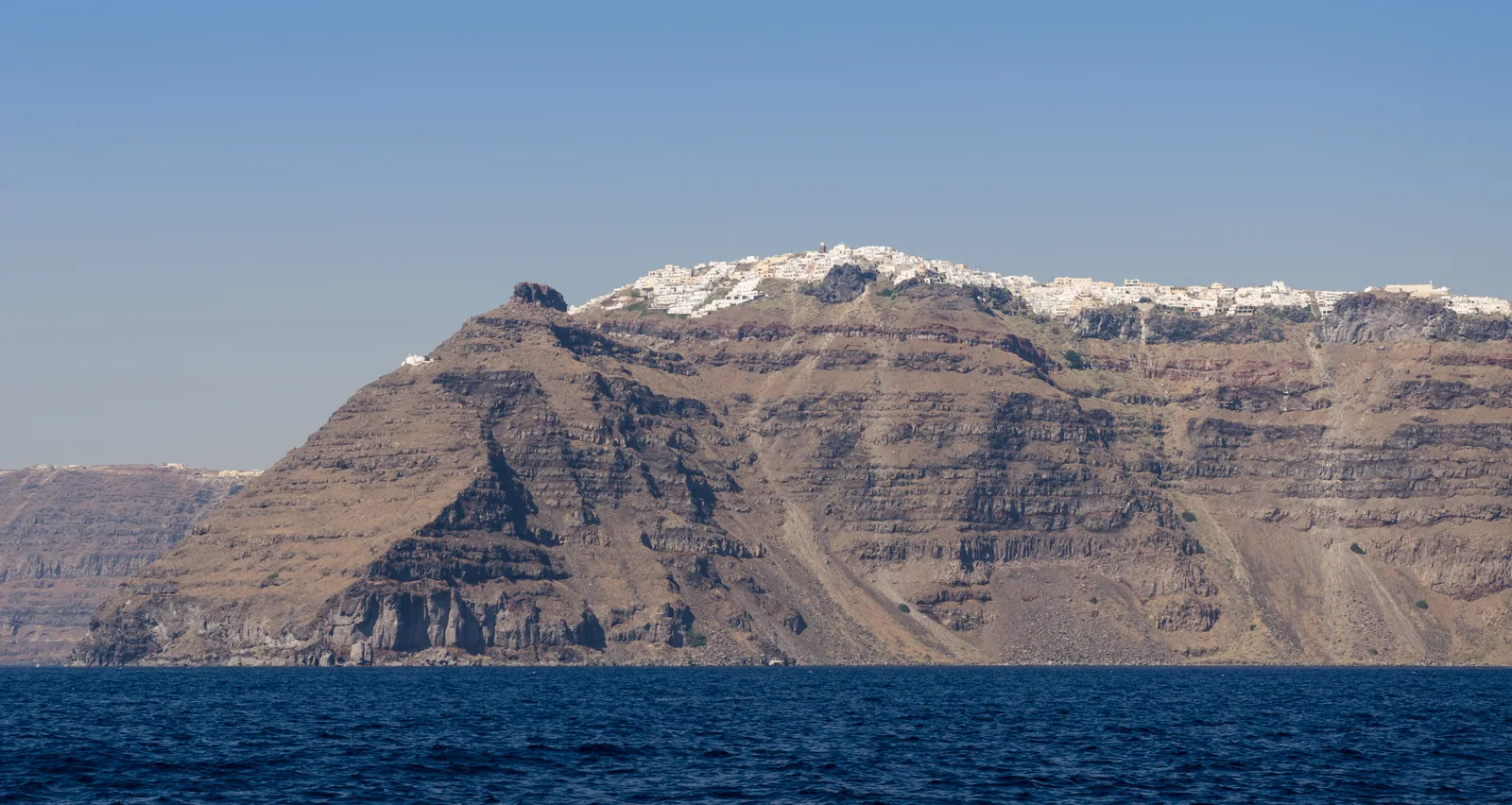
Santorini is really two islands in one. The west side is the famous caldera: whitewashed villages perched on cliffs up to around 300 meters (1,000 feet) above the flooded volcanic crater, with the sunset views on every postcard. The east and south coasts slope gently down to long black-sand beaches. Where you stay decides which Santorini you get, and how much you pay for it.
Santorini areas at a glance
| Area | Best for | Pros | Cons |
|---|---|---|---|
| Fira | First-timers, transport, nightlife | Main bus hub, restaurants, caldera views | Busy, especially on cruise-ship days |
| Firostefani | Couples who want views and walkability | Quieter than Fira, 10–15 minutes’ walk from it | Caldera hotels are pricey |
| Imerovigli | Honeymoons, sunsets, peace and quiet | The highest point of the caldera rim, Skaros Rock | Few shops; lots of steps |
| Oia | The iconic setting | Blue domes, famous sunset, cave houses | Crowded at sunset; the most expensive area |
| Kamari | Families, beach holidays, value | Long beach with a promenade, close to the airport | No caldera views |
| Perissa and Perivolos | Budget, beach bars, longer stays | Long black-sand beach, wide range of prices | Far from Oia; no caldera views |
| Pyrgos and Megalochori | Village atmosphere, wine, drivers | Traditional inland villages, central location | You’ll want a car or ATV |
Caldera or beach: the big decision
Caldera hotels sell the view: private terraces, plunge pools and cave rooms carved into the cliff. But there are no beaches below the caldera villages, and reaching many caldera hotels means carrying luggage down (and later up) a lot of steps. That matters for travelers with limited mobility or small children.
Beach areas on the east and south coasts cost noticeably less for the same standard of room. You can still see the caldera sunset by taking a bus or taxi to Fira, Imerovigli or Oia for the evening.
A popular compromise: split your stay. Spend two or three nights on the caldera for the views, then move to Kamari or Perissa for beach days.
Fira
Fira is the island’s capital and the hub of the KTEL bus network, so it’s the easiest base without a car. The caldera-edge path is lined with bars and restaurants, and the old port below is reached by cable car or a long flight of steps. The trade-off is crowds: when cruise ships anchor in the caldera, the town center can be packed from mid-morning to late afternoon. Staying on the edges of Fira often gives you the convenience without the noise.
Firostefani
Firostefani starts where Fira ends, roughly 1 km to the north along the rim path. It has the same views with a calmer feel, and you can walk to Fira’s restaurants in 10 to 15 minutes. It’s one of the best all-round choices for couples.
Imerovigli
About 3 km north of Fira, Imerovigli sits at the highest point of the caldera rim and looks out over Skaros Rock, the site of a former castle settlement. It’s quiet, romantic and popular for honeymoons. There’s little nightlife and only a handful of shops, so plan on taxis or the bus for evenings in Fira or Oia.
Oia
Oia, at the island’s northern tip, is the village of the famous blue domes and the most photographed sunset in Greece. Staying here means you can enjoy the lanes early in the morning, before the day-trippers arrive. Expect the highest prices on the island and very busy evenings around sunset viewpoints. The caldera-rim hiking trail from Fira to Oia is around 10 km and takes about three to four hours. Start early and bring water.
Kamari
Kamari, on the east coast, has a long dark-sand and pebble beach with a promenade of tavernas and hotels. It’s a few minutes from the airport, has regular buses to Fira, and suits families and anyone who wants a classic beach holiday. Ancient Thera, an archaeological site on the mountain above, can be visited from here.
Perissa and Perivolos
South of Kamari, on the other side of the Mesa Vouno mountain, Perissa and neighboring Perivolos share a long black-sand beach backed by beach bars and accommodation at most price points. It’s the island’s best-value base for a beach-focused stay. Buses run to Fira, but Oia is a long trip away.
Pyrgos and Megalochori
These inland villages have narrow lanes, churches and some of the island’s wineries, with far fewer crowds than the caldera towns. They’re central for exploring, but you’ll want your own transport.
Getting around
- Buses: KTEL buses radiate from Fira to Oia, Kamari, Perissa, the airport, Athinios port and other villages. There’s no direct airport-to-Oia service, so expect to change in Fira.
- Taxis: there are relatively few taxis for the number of visitors in summer. Pre-booking an airport or port transfer saves a long wait. GetTransfer (affiliate link) lets you request a private transfer and compare offers from local drivers.
- Car or ATV hire: useful for beaches and villages, but parking in Fira and Oia is very limited in high season. Many visitors hire for a day or two rather than the whole stay.
When to go
The main season runs from about May to October. July and August are the hottest and busiest months, with the highest room rates. May, June, September and early October are usually the best balance of warm weather, sea temperatures and prices. In winter many hotels and restaurants close, especially in Oia and the beach resorts.
Budget tip: Greek hotels charge a per-room, per-night climate resilience fee on top of the room rate. It’s higher in summer and for higher hotel categories. Check whether it’s included in the price you’re shown.
Things to do
The most popular bookable experiences are a boat trip into the caldera to walk on the volcano at Nea Kameni and swim at the hot springs, and a visit to Akrotiri, the Bronze Age town preserved under volcanic ash. You can browse Santorini tours and tickets on Tiqets (affiliate link), or buy archaeological site tickets at the entrance.
Getting to Santorini
Santorini International Airport (JTR) is on the east coast, roughly 6 km from Fira. Airlines including easyJet, Jet2, British Airways, TUI and Ryanair run mainly seasonal direct flights from the UK. Check the current schedule for your airport.
Out of season, or if there’s no direct route from your airport, fly to Athens and connect on a domestic flight of under an hour, or take a ferry from Piraeus or Rafina. High-speed ferries take around five hours or more, and conventional ferries take longer. Ferries arrive at Athinios port, about 10 km south of Fira. In summer, ferries also link Santorini with Heraklion in Crete.
Search flights to Santorini
Each button opens our flight search with the route pre-filled for one adult. Pick your dates and number of travelers, then compare airlines and booking sites. “London” covers all London airports.
- ✈ Check flights: London → Santorini
- ✈ Check flights: Manchester → Santorini
- ✈ Check flights: Birmingham → Santorini
- ✈ Check flights: Edinburgh → Santorini
These are affiliate links: if you book through them we may earn a commission, at no extra cost to you. Prices are shown by the booking site in the currency you select. See our affiliate disclosure.
Plan the rest of your trip
- Flights to Athens from the UK, the main year-round gateway to the islands
- Athens airport to the city center: metro, bus and taxi
- Where to stay in Athens for a night or two before the ferry
- Where to stay in Crete, if you’re combining the two islands
How we research: this guide is based on official sources and published airline and transport schedules, not on a sponsored visit. Information was checked on October 8, 2026. Schedules, routes and prices change, so confirm with the airline, operator or venue before you travel.
Sources
- Greek National Tourism Organisation: visitgreece.gr
- Hellenic Ministry of Culture (Akrotiri, Ancient Thera): odysseus.culture.gr
- KTEL Santorini (bus routes and timetables): ktel-santorini.gr
- Fraport Greece (operator of Santorini airport): jtr-airport.gr
- Hellenic Ministry of Tourism (climate resilience fee): mintour.gov.gr
- Airline websites: easyjet.com, jet2.com, britishairways.com, tui.co.uk, ryanair.com, aegeanair.com, skyexpress.gr
Featured image: Imerovigli and the caldera rim, Santorini. Photo: Norbert Nagel, July 14, 2012, via Wikimedia Commons (file “Imerovigli and crater rim – Santorini – Greece – 01.jpg”), CC BY-SA 3.0 (creativecommons.org/licenses/by-sa/3.0). Resized and compressed.

We research Cyprus and Greece trips for travelers from the UK and Europe, using official tourism, airport and transport sources and published airline schedules. No sponsored rankings. How we research · How we earn